Call Now: 405-601-4227

Current Patient And Need To Get In Touch?
Contact Us Here
Call Now: 405-601-4227
Residual Knee Pain After Knee Replacement
Home » Services & Conditions Treated » Knee Pain » Residual Knee Pain After Knee Replacement
Roughly one in five patients who undergo total knee replacement still experience significant knee pain after surgery, even when the implant is functioning correctly, and no clear surgical complication exists. For these patients, the pain does not resolve on its own with time. It requires a different kind of evaluation and a different category of treatment than what orthopedic surgeons typically offer after the initial procedure.
At Comprehensive Spine and Pain, our double board-certified pain management physicians specialize in exactly this scenario. We evaluate the source of pain that persists after knee replacement and apply interventional techniques as appropriate. Call (405) 601-4227 or contact us online to schedule an evaluation.
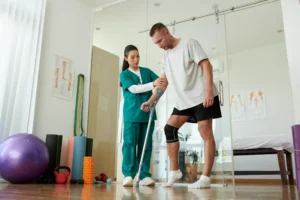 Chronic knee pain after knee replacement that persists beyond the normal recovery window, typically three to six months post-surgery, is known as residual pain. This is different from the expected soreness that follows any major joint procedure. Pain that persists or worsens after the implant has healed suggests the source is not the mechanical joint itself but rather the nerves, soft tissue, or surrounding structures that the replacement did not address. Knee pain years after replacement is not unusual and does not always indicate implant failure.
Patients describe a range of symptoms after knee replacement, including:
Each pattern points to a different underlying mechanism, and identifying that mechanism is the starting point for effective treatment.
Knee pain after a knee replacement may persist due to:
Our physicians always examine the underlying cause to ensure we design the most effective treatment plan.
 Orthopedic surgeons are the right resource for structural implant problems. Pain management physicians are the right resource when the implant is intact, but pain continues. An evaluation at Comprehensive Spine and Pain is appropriate when:
Most patients with persistent pain after knee replacement do not need revision surgery. At Comprehensive Spine and Pain, we begin with the least invasive effective approach for each patient’s specific pain pattern.
Targeted rehabilitation addresses muscle imbalances, movement pattern errors, and soft tissue restrictions that contribute to ongoing pain after replacement. Therapy focuses on quadriceps activation, hamstring flexibility, gait retraining, and reducing compensatory patterns that develop when patients move to avoid pain. Our physicians coordinate rehabilitation timing with any interventional procedures so patients can participate in therapy more productively.
For patients with inflammatory or nerve-related pain, appropriately selected medications can reduce baseline discomfort enough to allow other treatments to work. Our practice offers both opiate and non-opiate medical management within the context of the patient’s complete treatment plan.
Before committing to a longer-acting procedure, many patients undergo diagnostic genicular nerve blocks to confirm that the genicular nerve network is the primary pain source. Local anesthetic is delivered to the superomedial (upper inner), superolateral (upper outer), and inferomedial (lower inner) genicular nerves. Significant temporary pain relief confirms that the nerves are responsible and that radiofrequency ablation is likely to be effective.
When inflammation is contributing to pain, image-guided corticosteroid injections can provide meaningful relief. These are performed in our procedure suite under fluoroscopic guidance and are often used alongside other treatments.
When these treatments fail to relieve your residual knee replacement pain, we can discuss further options with you.
Genicular nerve radiofrequency ablation is one of the most well-supported interventional treatments for chronic pain following total knee replacement. The procedure uses heat to disrupt the sensory nerve fibers responsible for transmitting pain signals from the knee. Research shows significant reductions in pain scores, with high rates of patient-reported global improvement. Unlike revision surgery, it is performed entirely in our office with no general anesthesia and no hospital stay.
For patients with nerve-related pain that has not responded adequately to blocks or radiofrequency ablation, peripheral nerve stimulation delivers low-level electrical pulses near the affected nerve to interrupt pain signaling. This is particularly useful when the pain pattern is diffuse or involves nerve territories difficult to target with ablation alone.
In severe, chronic cases resistant to other interventional approaches, spinal cord stimulation can be considered. A trial period allows patients to assess the effectiveness before a permanent device is implanted.
In most cases, persistent pain after knee replacement responds to interventional treatment without requiring a return to surgery. If imaging or diagnostic workup identifies a structural problem with the implant, such as loosening, malalignment, or wear, revision surgery may be the appropriate next step. In those situations, our physicians will communicate findings clearly and refer patients back to their orthopedic surgeon. Our role is to ensure every non-surgical option has been appropriately evaluated before that conversation happens.
Patients dealing with pain after knee replacement often feel dismissed after orthopedic follow-up confirms the implant is intact. Comprehensive Spine and Pain is one of the only practices in Oklahoma that combines the full spectrum of interventional pain procedures with medication management under one roof. Our pain management physicians perform all treatments in our on-site procedure suites, with the same physicians evaluating and coordinating every aspect of your care.
Research suggests approximately 20% of patients experience persistent pain after total knee arthroplasty. Significant ongoing pain that limits function is not an expected long-term outcome and warrants evaluation by a pain management specialist, particularly if orthopedic follow-up has not identified a structural cause.
Genicular nerve blocks, radiofrequency ablation, and peripheral nerve stimulation all target the nerves surrounding the knee rather than the implant or joint structure itself. These procedures do not alter the anatomy of the replacement or affect a surgeon’s ability to perform revision surgery if that becomes necessary. Patients considering both paths can pursue interventional treatment without closing off surgical options.
The genicular nerves can regenerate over time, which means pain may return months to over a year after the procedure. When that happens, the ablation can be repeated. Many patients go through more than one course of treatment and continue to get meaningful relief with each one. Our physicians will monitor your response and discuss retreatment timing based on how your symptoms evolve.
There is no required waiting period. Patients can seek a pain management evaluation as soon as persistent pain becomes a concern, even if orthopedic follow-up is still ongoing. If pain continues beyond three to six months without meaningful improvement, or if burning, tingling, or nerve-related symptoms develop sooner, an evaluation at Comprehensive Spine and Pain is appropriate at that point. Early evaluation allows our physicians to identify the pain source and begin treatment before symptoms become more entrenched.
Persistent pain after knee replacement does not mean the surgery failed or that revision is inevitable. In many cases, it means the pain source was not fully addressed by the orthopedic procedure and requires a different clinical approach. At Comprehensive Spine and Pain, we evaluate each patient’s specific pain pattern and develop a targeted treatment plan using the interventional options best suited to that mechanism.
Contact us to schedule your evaluation at our Oklahoma City office.
Our firm is located near you. Serving Oklahoma City, Oklahoma County, and communities throughout central Oklahoma.
Comprehensive Spine and Pain – Oklahoma City
301 SW 80th St, Suite 101
Oklahoma City, OK 73139
Find us with our GeoCoordinates 35.38828979825202, -97.5176510455269